
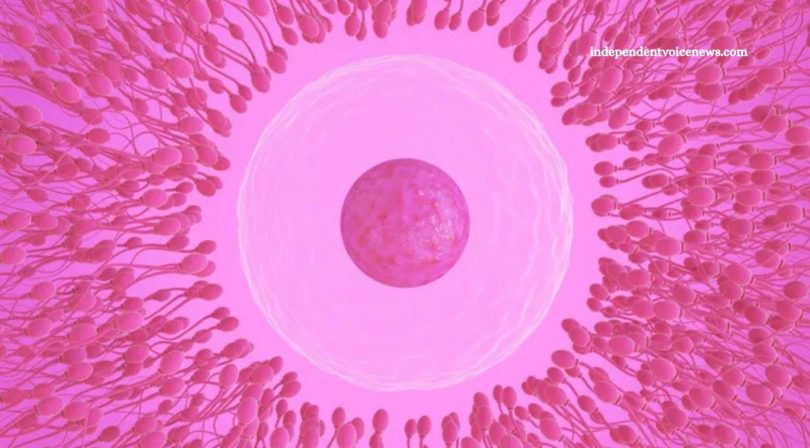

The popular image of sperm as fierce competitors in a race to reach the egg has long shaped our understanding of human reproduction. In this widely accepted narrative, sperm battle each other toward a passive egg that simply waits to be fertilized by the fastest one. However, modern science tells a very different story. Research consistently shows that the egg plays an active role in selecting which sperm succeeds—challenging the outdated myth of “racing sperm.”
Science writer Starre Vartan explores this misconception and others in her upcoming book, The Stronger Sex: What Science Tells Us About the Power of the Female Body (Seal Press/Hachette, 2025). Drawing on the latest scientific findings, Vartan reveals how longstanding biases—and a historic lack of female-focused research—have distorted our understanding of biology and gender.
Why Eggs Are Selective: Understanding the Evolution of Human Reproduction
Unlike males, who produce sperm continuously throughout life, human females are born with a finite number of eggs—an evolutionary strategy that reflects a major shift in reproduction. According to Professor Lynnette Sievert, a biological anthropologist at the University of Massachusetts Amherst, this mammalian adaptation favors quality over quantity. Females make all their eggs early in life, rigorously test and discard many, and release just one at a time for potential fertilization.
In contrast, many fish, amphibians, and reptiles still rely on an older reproductive model: producing vast numbers of eggs and sperm continuously. Female frogs and fish release thousands of eggs into the environment, while males disperse sperm nearby in hopes of fertilization. Fertilized eggs face high odds—subject to environmental factors, predators, or random chance. Sea turtles, for example, may lay hundreds of eggs at once well into old age, as do oviparous snakes.
For these species, reproduction is a numbers game. Few offspring survive to adulthood, but the sheer volume increases the odds. This high-output strategy remains in human males—but not in females, whose reproductive systems are designed for selectivity, not abundance.
Read More: Japan Breaks Internet Speed Record: 4 Million Times Faster Than Average US Broadband
The Egg’s Choice: How Female Biology Flips the Script on Reproduction
For generations, we’ve been told the same story about reproduction: a race of millions of sperm, each frantically swimming toward a waiting egg, where only the fastest, strongest, and most determined succeed. It’s a compelling image—competitive, dramatic, and conveniently aligned with cultural narratives that reward male action and female passivity.
But this story is largely a myth.
Scientific research over the last four decades has painted a very different picture. In reality, the egg is not a passive participant in fertilization. It’s a gatekeeper—actively selecting sperm through biochemical signaling and rejecting those that don’t meet its criteria. In fact, some researchers argue that the egg holds the final say in human conception.
And yet, the myth of the “racing sperm” persists.
Reproductive Strategy: From Fish to Humans
“Human males still follow the fish pattern,” says Professor Lynnette Sievert, a biological anthropologist at the University of Massachusetts Amherst. “They’re still putting out a million sperm. They’re not cleaning the sperm, they’re not putting out the best sperm, they’re just putting out all the sperm—just like a fish.”
Indeed, in many aquatic species like fish and amphibians, reproduction is a numbers game. Female frogs or fish release thousands of eggs into the environment, and males flood the water with sperm in hopes that some will connect. Fertilization and survival depend heavily on external environmental conditions—temperature, pollution, predators—not internal biological decisions.
But female mammals, including humans, abandoned this strategy long ago.
Instead of releasing thousands of eggs, they produce a limited number early in life, carefully select which ones mature, and typically allow just one to be available for fertilization at a time. That fundamental shift in strategy raises a big question: why?
Sievert proposes one likely reason: control.
The Power of Internal Fertilization
In mammals, fertilization occurs inside the female body, offering a unique opportunity for control over the reproductive process. This internal environment allows the female reproductive system to influence not just which egg is released, but which sperm it allows to fertilize that egg.
This reproductive strategy requires significant energy, but it offers major advantages—especially for longer-lived species. Instead of relying on chance, mammals can “fine-tune” reproduction based on internal and external cues, helping ensure their offspring are well-suited to current conditions.
Cat Bohannon, in her book Eve: How the Female Body Drove 200 Million Years of Evolution, describes this as “turning your body into an eggshell.” By internalizing reproduction, mammals shift from external randomness to internal selectivity—a process shaped by millions of years of evolutionary pressure.
The Egg is Not Passive
The myth of the passive egg was once widely accepted in both science and culture. In the 1980s, however, that view began to change. Scientists discovered that the egg’s outer layer—the zona pellucida—contains proteins that can recognize and bind to specific sperm. This chemical interaction allows the egg to effectively “test” sperm and choose which one it will admit.
The sperm doesn’t penetrate the egg through brute force. Instead, the egg permits entry—if and only if it detects the right molecular match.
Despite this breakthrough, the old narrative persists. As recently as 2017 and 2019, publications referred to this fact as a “new discovery.” A University of Virginia magazine piece described the egg as “not the submissive, docile cell” it was thought to be, and called the revelation “unexpected”—even though decades of research supported it.
Feminist philosophers like Evelyn Fox Keller have long highlighted how gendered assumptions can shape scientific narratives. In her work, Keller emphasized that what we consider “neutral” biological concepts often carry deep cultural biases—especially around gender roles.
New Research: Eggs May Choose Sperm Before Fertilization
Perhaps the most compelling evidence for egg-driven selection comes from recent studies showing that eggs can influence sperm behavior even before they meet.
In 2020, researchers from Stockholm University and the University of Manchester studied sperm and follicular fluid (the fluid that surrounds the egg) from couples undergoing IVF. They discovered that the eggs released chemical signals that attracted certain sperm more than others. Strikingly, some eggs showed a preference for sperm from non-partner males—suggesting that chemical compatibility may matter more than monogamous pairing.
“Eggs don’t always attract sperm from their partners,” the researchers wrote. “This shows that interactions between human eggs and sperm depend on the specific identity of the women and men involved.”
This chemosensory communication allows for female choice at the molecular level. The egg might be selecting sperm based on genetic compatibility, immune system diversity, or some other as-yet-unidentified quality that enhances the survival chances of potential offspring.
While the precise criteria remain unknown, the implications are profound: fertilization is not random, and the female body plays an active, intelligent role in shaping human life from the very beginning.
Fewer Babies, Higher Investment
This highly selective process makes sense in the context of human reproductive patterns. Unlike fish or turtles, humans don’t produce hundreds of offspring. Instead, they typically have one baby at a time—maybe a few over a lifetime. When reproduction is this limited, it becomes evolutionarily advantageous to invest heavily in each one.
This investment begins even before conception. Eggs “compete” within the ovaries each month, and only the strongest is released. Once in the fallopian tube, that egg begins emitting signals to attract preferred sperm. If fertilization occurs, the female body then supports the embryo’s development for nine months, followed by years of parental care.
In this light, the egg’s choosiness isn’t just a quirk of biology—it’s a strategic adaptation, honed over millions of years to give every child the best possible start in life.
Cultural Narratives Lag Behind the Science
If the science is clear, why does the myth of racing sperm and passive eggs still dominate textbooks, classrooms, and pop culture?
The answer lies not in biology but in cultural inertia. As Emily Martin detailed in her influential essay The Egg and the Sperm, science has historically mirrored the gender stereotypes of the society in which it was produced. Active males and passive females were assumed not just socially but biologically—and these assumptions influenced how scientific data was interpreted and communicated.
Even now, as the evidence grows, many still find the idea of a powerful, selective egg unsettling—or surprising.
It’s not just the public; even researchers in scientific journals sometimes frame the egg’s role as a radical or recent discovery, despite decades of data to the contrary.
As Evelyn Fox Keller argued, science must recognize that it is a cultural enterprise as much as a rational one. If our understanding of basic biology is colored by outdated gender norms, it’s no wonder that progress in women’s health and reproductive science has lagged behind.
Redefining the Story of Reproduction
It’s time to revise the narrative. The science is in: eggs are active participants in reproduction. They attract, assess, and admit sperm based on criteria we are only beginning to understand. This agency begins before fertilization and shapes not just which sperm succeeds, but which future life is even possible.
Recognizing the egg’s role isn’t just about correcting a biological error—it’s about dismantling deep-seated cultural assumptions that have long framed female biology as weak, passive, or secondary.
In truth, the female reproductive system is among the most powerful, selective, and finely tuned mechanisms in nature. Understanding that doesn’t just give us better science—it gives us a better story.
Frequently Asked Questions
Do eggs really choose which sperm fertilizes them?
Yes. Scientific research has shown that human eggs play an active role in selecting sperm. The egg’s outer layer, the zona pellucida, interacts chemically with sperm, admitting only those that are compatible. Recent studies also suggest that eggs release chemical signals to attract specific sperm, even before they make contact.
Why has the idea of ‘racing sperm’ persisted for so long?
The “racing sperm” myth reflects long-standing cultural beliefs that prioritize male action and female passivity. Historically, biology has been interpreted through a gendered lens, reinforcing stereotypes rather than reflecting scientific reality. Despite modern discoveries, these narratives remain embedded in education, media, and even some scientific publications.
Is sperm completely passive in fertilization?
Not entirely. Sperm are motile and must reach the egg, but they cannot force their way in. The final decision lies with the egg, which determines whether or not to accept the sperm’s DNA. Sperm that aren’t compatible will be rejected, regardless of how “fast” or “strong” they are.
How does this understanding affect human fertility research or IVF?
Understanding egg-sperm interaction can greatly improve outcomes in fertility treatments. If eggs can detect genetic compatibility, IVF clinics might consider biochemical matching between eggs and sperm to increase success rates. It also reshapes how scientists view unexplained infertility cases.
Why don’t school textbooks teach this updated science?
Many educational materials are slow to adapt to new research, especially when it challenges traditional views. The persistent “racing sperm” narrative is easy to visualize and dramatic, which makes it memorable—but scientifically inaccurate. There’s a growing push to update biology curricula to reflect more accurate reproductive science.
What does this mean for our understanding of female biology?
It challenges the outdated notion of female biology being passive or secondary. Female reproductive systems are incredibly active, selective, and sophisticated, with the ability to filter out weak or incompatible sperm before fertilization even occurs. This recognition can lead to more balanced, accurate science education and healthcare.
Are other animals’ eggs also selective?
Yes. Egg selectivity isn’t unique to humans. Studies across mammals, invertebrates, and even some fish show that eggs can influence sperm behavior or select sperm based on chemical cues, genetic diversity, or environmental factors. It’s an evolutionary strategy seen in many species.
Conclusion
The myth of sperm as the heroic winner in a high-stakes race to the egg has dominated our understanding of reproduction for generations. But science tells a different—and more accurate—story: the egg plays a powerful, active role in selecting sperm, shaping the earliest stages of human life through biochemical communication and compatibility testing.
This shift in understanding isn’t just a matter of biology—it challenges deeply ingrained cultural narratives about gender, agency, and reproduction. As research continues to uncover the remarkable selectivity and intelligence of the female reproductive system, it becomes clear that reproduction is not a game of chance or speed, but of cellular communication, compatibility, and evolutionary strategy.