
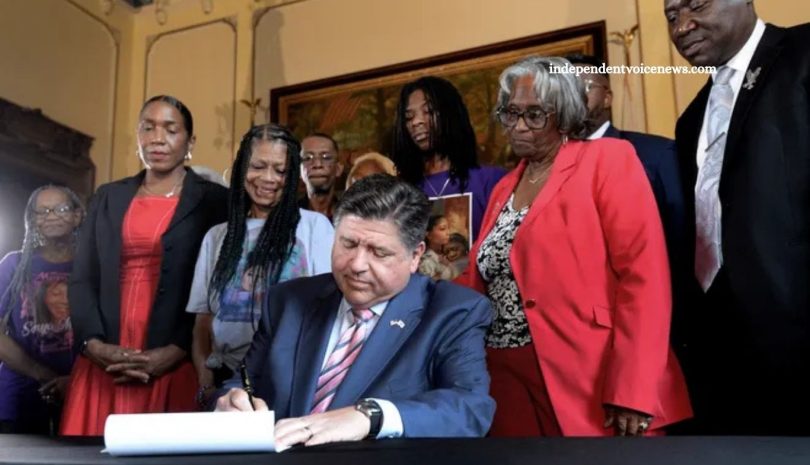

SPRINGFIELD, IL — Gov. JB Pritzker has signed the Sonya Massey Act, a new Illinois law requiring law enforcement agencies to conduct more thorough background checks on prospective officers. The legislation follows the 2024 fatal shooting of Sonya Massey, a Black woman shot in the face by a sheriff’s deputy in her home.
Key provisions include mandatory access to full employment histories, the creation of merit boards for hiring deputies in smaller jurisdictions, and expanded vetting protocols across all law enforcement entities—from township to park police.
State Sen. Doris Turner, who introduced the bill, called it the most significant effort of her 25-year legislative career. “Had this law existed earlier, Sonya might still be alive,” Turner said. “We can’t control who agencies hire, but we can ensure they have every piece of information available.”
Read More: Canada Joins France and UK in Move to Recognize Palestinian State
What Happened to Sonya Massey?
Sonya Massey, 36, a mother of two, was fatally shot inside her Springfield home on July 6, 2024, by Sangamon County Sheriff’s Deputy Sean P. Grayson. Massey had called 911 to report a possible intruder. Disturbing video footage shows the unarmed woman apologizing and ducking for cover moments before Grayson opened fire.
Her killing ignited nationwide protests against police brutality and triggered a Justice Department investigation. Public outcry intensified when it was revealed Grayson had a documented history of misconduct involving women. The sheriff who hired him resigned amid growing criticism, and Grayson was later fired and indicted on multiple charges, including murder.
Law Enforcement Helped Shape the Sonya Massey Act
In response to Sonya Massey’s death, former officers and experts pointed to lax vetting standards as a factor in poor police hires. Illinois State Sen. Doris Turner confirmed that the Illinois Association of Chiefs of Police and the Illinois Sheriffs’ Association collaborated with lawmakers to draft the Sonya Massey Act.
Kenny Winslow, Executive Director of the Chiefs of Police Association, emphasized the need for minimum background standards, stating the bill moves Illinois closer to ensuring only candidates of strong moral character serve in law enforcement.
Legislators say the bill sets a precedent with some of the toughest employment screening standards for police agencies in the nation.
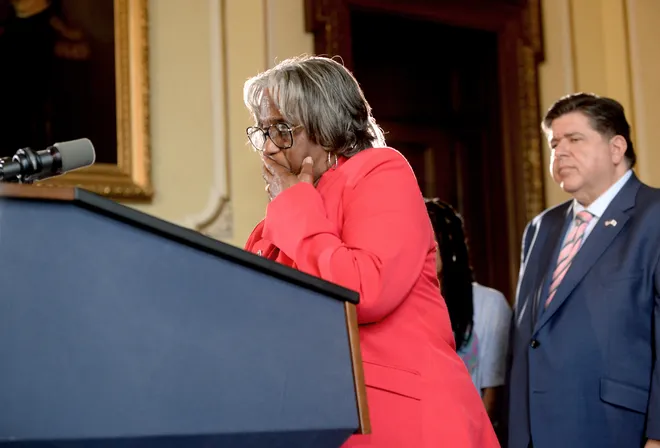
Massey’s Family Attends Bill Signing Ceremony
Gov. JB Pritzker signed the Sonya Massey Act in front of Massey’s family, including her mother Donna Massey, father James Wilburn of Pine Bluff, Arkansas, and her two children, Malachi and Summer of Springfield. Civil rights attorney Ben Crump, who secured a $10 million civil settlement for the family, also attended.
Pritzker, who met with the family after the 2024 shooting, reflected on Massey’s memory. “She loved and was loved—and was taken far too soon,” he said. “This law should inspire similar action in states across the country.”
What’s Included in the Sonya Massey Act (Senate Bill 1953)
Senate Bill 1953 aims to prevent future tragedies by requiring law enforcement agencies to fully assess an officer’s fitness for duty before making a job offer. The law mandates stricter background checks, expands sheriff’s merit boards and commissions in counties with populations over 75,000, and enforces consistent hiring standards across agencies.
Gov. JB Pritzker said the bill strengthens public safety and ensures officers with serious disciplinary histories aren’t hired. Sen. Doris Turner praised the collaboration with law enforcement groups to set firm standards for responsible policing. The bill passed both chambers with strong bipartisan support.
What to Know About Deputy Sean P. Grayson
Hired by the Sangamon County Sheriff’s Office in May 2023 with a $56,000 salary, Sean P. Grayson brought a troubling record. He had two DUIs, a U.S. Army discharge for “serious misconduct,” and multiple complaints from both civilians and fellow officers.
Grayson held five law enforcement jobs since 2020—some overlapping and part-time. Despite a hiring interview warning that he “needs to slow down to make good decisions,” the department proceeded with his employment. A USA TODAY investigation also uncovered several complaints accusing Grayson of aggressive behavior toward women.
Family ‘Cautiously Optimistic’ After Bill Signing
Sen. Doris Turner, a longtime friend of the Massey family, said she spoke with Sonya Massey just a week before the tragic shooting. “She wasn’t just a constituent—I’ve known multiple generations of the Masseys,” Turner said.
Sonya’s cousin, Sontae Massey, expressed cautious optimism following the bill’s signing. “We’ll savor the small victories, but this marks only the start of a long fight for justice and equity,” he told The State Journal-Register.
Frequently Asked Questions
What is the Sonya Massey Act?
The Sonya Massey Act (Senate Bill 1953) is a new Illinois law that mandates stricter background checks and hiring standards for law enforcement officers across the state. It was signed into law by Gov. JB Pritzker on August 12, 2025.
Why was this law introduced?
The legislation was prompted by the 2024 killing of Sonya Massey, an unarmed Black woman shot by a Sangamon County sheriff’s deputy with a known history of misconduct. The case sparked national outrage and calls for reform.
Who helped craft the bill?
The Illinois Association of Chiefs of Police and the Illinois Sheriffs’ Association collaborated with legislators to shape the bill. Law enforcement leaders supported the measure to raise hiring standards statewide.
Was there bipartisan support for the bill?
Yes. The Illinois House and Senate passed the bill with strong bipartisan support, reflecting broad agreement on the need for reform in police hiring practices.
Who is Sean P. Grayson, and why is he central to the bill?
Sean P. Grayson was the deputy who fatally shot Sonya Massey. He had a history of misconduct, including DUIs, a military discharge for serious misconduct, and multiple complaints from both civilians and officers. Despite red flags, he was hired by the Sangamon County Sheriff’s Office—highlighting the gaps this bill seeks to close.
How has Massey’s family responded to the new law?
Sonya Massey’s family, including her mother and children, attended the bill signing. While they welcomed the legislation, her cousin Sontae Massey described the moment as a “small victory” in a longer fight for justice and equity.
Conclusion
The signing of the Sonya Massey Act marks a pivotal step toward reforming police hiring practices in Illinois. By enforcing stricter background checks and standardized vetting procedures, the law aims to prevent unqualified or dangerous individuals from serving in law enforcement. While it cannot undo the tragic loss of Sonya Massey, it stands as a powerful response to injustice—and a call for accountability across all levels of policing. With bipartisan support and collaboration from law enforcement leaders, Illinois is setting a precedent for other states to follow in the pursuit of safer, more equitable communities.