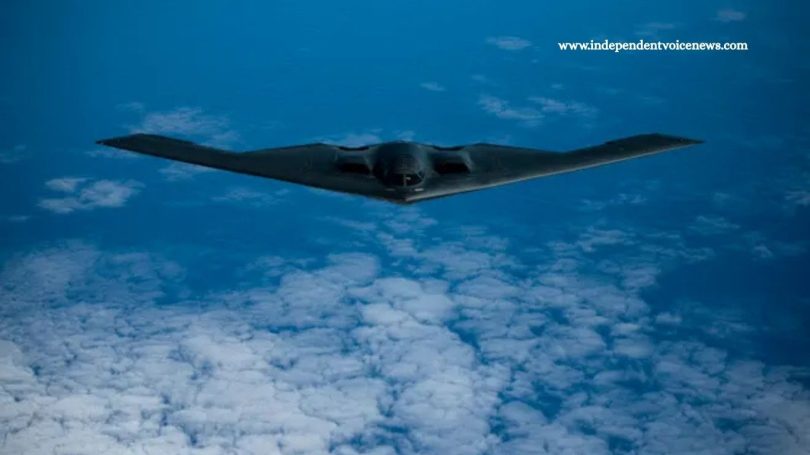

Early on June 21, a fleet of elite B-2 stealth bombers launched from Whiteman Air Force Base in Missouri to strike three Iranian nuclear sites. President Donald Trump later confirmed the targets—Fordow, Natanz, and Esfahan—calling the operation a “very successful attack.”
Valued at approximately $2 billion each, B-2 bombers combine advanced stealth with long-range capabilities, carrying powerful bunker-busting bombs designed to destroy deeply buried facilities.
Whiteman Air Force Base, located southeast of Kansas City, Missouri, houses the entire fleet of 19 B-2 bombers. Its 509th Bomb Wing, under Air Force Global Strike Command, proudly projects U.S. airpower globally from this strategic base.
What is the B-2 Spirit?
B-2 Spirit stealth bombers carry America’s heaviest conventional and nuclear weapons. Their flying-wing shape, composite materials and radar-absorbent coating slash radar cross-section, making detection extremely difficult. All 19 bombers deploy nuclear gravity bombs but lack cruise-missile capability (Congressional Research Service, June 18). Unique among U.S. aircraft, the B-2 alone carries the Massive Ordnance Penetrator (GBU-57), the most powerful bunker-busting bomb.
Read More: Trump Faces Growing Opposition from Millions of Americans as He Refuses to Back Down
What are the B-2 Spirit’s specifications?
The B-2 Spirit operates with a two-pilot crew, spans 172 feet, and measures 69 feet in length. Weighing 160,000 pounds, each bomber can carry two GBU-57 bunker-busting bombs. With advanced stealth technology and precision capabilities, its development and construction are estimated at approximately \$2 billion per aircraft.
How has the B-2 bomber been used?
B-2 bombers have a history of global combat operations, showcasing unmatched range and precision. In April, up to six B-2s were deployed to the U.S.-British base on Diego Garcia, according to Reuters. Previously, they played key roles in major missions—from destroying 33% of Serbian targets during Operation Allied Force to long-range strikes from Missouri to Kosovo, Afghanistan, and Iraq.
During Operation Iraqi Freedom, B-2s flew 49 sorties, dropping over 1.5 million pounds of munitions. In 2017, two B-2s conducted strikes in Libya, targeting ISIS and al-Qaeda militants. More recently, in October 2024, they struck Iran-backed Houthi rebels in Yemen. Defense Secretary Lloyd Austin called it a clear demonstration of the U.S.’s ability to destroy deeply buried, fortified targets anywhere in the world.
How does a bunker busting bomb work?
A bunker-busting bomb is designed to penetrate hardened structures like underground bunkers, command centers, or nuclear facilities before detonating. Here’s how it works:
🔧 Design & Mechanics
- Heavy, Dense Casing: Made of reinforced steel or specialized alloys, allowing the bomb to survive high-impact forces.
- High Velocity: Dropped from high altitudes, these bombs gain tremendous speed and momentum to drive deep into the earth or concrete.
- Delayed Fuse: Instead of exploding on impact, they use a time-delay or penetration-sensing fuse, allowing the bomb to detonate after burrowing inside a target.
💣 Massive Ordnance Penetrator (GBU-57)
- Weight: 30,000 pounds (13,600 kg)
- Penetration: Can bore through 200+ feet of earth or 60 feet of reinforced concrete before detonation.
- Use Case: Specifically engineered for targets like Iran’s underground nuclear facilities.
Frequently Asked Questions
Where did the B-2 stealth bomber mission to Iran originate?
The mission began at Whiteman Air Force Base in Missouri, the home base of the entire B-2 Spirit bomber fleet.
What targets were struck during the B-2 mission to Iran?
The bombers targeted three nuclear sites: Fordow, Natanz, and Esfahan, according to a statement by former President Donald Trump.
When did the strike take place?
The B-2s took flight on the morning of June 21, with the strike being publicly confirmed later that day.
What makes the B-2 bomber unique for such missions?
The B-2 combines stealth technology, long-range capability, and the ability to carry bunker-busting bombs, ideal for striking hardened or deeply buried targets.
What type of bomb was used in the mission?
The B-2s are capable of carrying the GBU-57 Massive Ordnance Penetrator, a 30,000-pound bomb designed to destroy fortified underground facilities.
How much does a B-2 bomber cost?
Each B-2 Spirit bomber costs approximately $2 billion, making it one of the most advanced and expensive aircraft in the U.S. arsenal.
How many B-2 bombers exist in the U.S. Air Force?
The U.S. maintains a fleet of 19 B-2 bombers, all stationed at Whiteman Air Force Base.
Have B-2 bombers been used in other military operations?
Yes. B-2s have seen action in Kosovo, Iraq, Afghanistan, Libya, and Yemen, playing key roles in strategic airstrikes across multiple operations.
Why are stealth bombers important for missions like this?
Stealth allows B-2s to evade radar detection, enabling them to penetrate heavily defended airspace and strike high-value targets without being intercepted.
Conclusion
The B-2 Spirit stealth bomber mission to strike Iran underscores the unmatched reach, precision, and power of U.S. strategic air capabilities. Launching from Whiteman Air Force Base in Missouri, the operation demonstrated the effectiveness of advanced stealth technology and bunker-busting weaponry against high-value, deeply fortified targets. As global threats evolve, the B-2 remains a critical asset in the U.S. military arsenal—capable of projecting force anywhere in the world with minimal detection and maximum impact.