
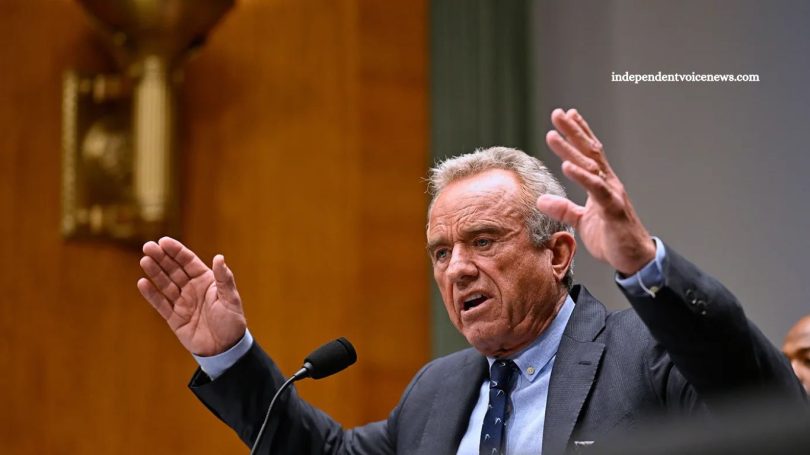

Robert F. Kennedy (RFK Jr.) will face tough questions today from senators concerned that his management of the Department of Health and Human Services (HHS) as a vaccine skeptic has fueled national confusion and heightened public health risks.
President Trump, who frequently praises Kennedy and his “Make America Healthy Again” agenda, shows no signs of reining in the controversial Cabinet pick. Kennedy has dismissed mainstream medical research and longstanding disease experts who champion vaccine safety and efficacy.
Senate Majority Leader John Thune (R-S.D.) said Kennedy must “restore public trust” as he prepares for “hard questions” from the Senate Finance Committee. Louisiana Republican Sen. Bill Cassidy, a physician who voted to confirm Kennedy, has criticized the secretary while navigating his reelection campaign.
Kennedy, a former lawyer, has repeatedly claimed—without scientific evidence—that vaccines are linked to autism, suggested childhood inoculations should be optional, and criticized pharmaceutical companies, including those involved in Operation Warp Speed.
Read More: Trump Reports 11 Terrorists Killed in Caribbean Drug Vessel Strike
Lawmakers are expected to question Kennedy about firing CDC Director Susan Monarez after she resisted his resignation request, despite Senate confirmation just a month prior. Several top CDC leaders resigned amid Kennedy’s attempts to control federal vaccine guidance, prompting calls for his resignation from current and former HHS staff.
Critics highlight Kennedy’s removal of CDC advisory panel members, replacing them with anti-vaccine activists, cutting $500 million from mRNA vaccine research, and limiting FDA COVID-19 shot approval this fall to seniors and high-risk individuals.
Sen. Ron Wyden (D-Ore.) and Sen. Angela Alsobrooks (D-Md.) released a report describing Kennedy’s tenure as an “unmitigated disaster.” The split between public health experts and Kennedy’s HHS has drawn criticism from scientists and doctors urging parents to consult physicians rather than rely on inconsistent federal guidance.
In response, California, Oregon, and Washington are reviewing scientific data independently, criticizing the CDC as “a political tool that increasingly peddles ideology instead of science.” Meanwhile, Florida announced plans to end all vaccine mandates, including for schoolchildren, with Surgeon General Joseph Ladapo calling mandates “wrong” and emphasizing personal choice. CMS Administrator Mehmet Oz expressed support for Florida’s move.
Amid this public health turmoil, Trump will host top tech and business leaders, including Mark Zuckerberg, Tim Cook, Bill Gates, and Sam Altman, at a White House Rose Garden event following a First Lady–hosted AI summit. The gathering reflects ongoing administration efforts to rally key sectors while navigating controversy in HHS.
Will Former President Clinton Testify in Epstein Probe?
Former President Bill Clinton and former Secretary of State Hillary Clinton are among those subpoenaed by House Oversight and Government Reform Committee Chair James Comer (R-Ky.) in the ongoing Jeffrey Epstein investigation.
Comer told me he has yet to hear back from the Clintons. “We’ve heard from everyone on that list except the Clintons,” he said. “They’ll have to answer the subpoena. I believe it’s in a couple of weeks, and I expect them to testify.”
Only five presidents, including Donald Trump, have ever faced congressional subpoenas. In the coming weeks, it will become clear whether Clinton complies or resists the committee’s request.
Blake Burman hosts Smart Take on The Hill, weeknights at 6 p.m. ET/5 p.m. CT on NewsNation.
3 Key Updates Today
Harvard University scored a temporary legal win against the Trump administration’s freeze of $2.2 billion in federal grants, as a federal judge ruled in the school’s favor.
Homeland Security Secretary Kristi Noem ended deportation protections for some Venezuelans, continuing the administration’s push to roll back Temporary Protected Status after multiple court setbacks.
Former President Trump is asking the Supreme Court to uphold his tariffs after an appeals court struck down most of them last week. The tariffs remain in effect while the Justice Department appeals.
Leading the Day: Epstein Files, Government Funding, and Key Congressional Moves
Epstein Files: Republican rebels intensified pressure on their own party Wednesday, urging the Trump administration to release Jeffrey Epstein-related files. Survivors of the late sex offender appeared at the Capitol, sharing emotional pleas for Congress to act.
Despite the demonstration, GOP leaders largely remained unmoved, instead backing an alternative bill to support the ongoing House Oversight investigation. This measure contrasts with a proposal by Reps. Thomas Massie (R-Ky.) and Ro Khanna (D-Calif.) that would compel the Justice Department to release nearly all files on Epstein and his associate Ghislaine Maxwell. The Massie petition needs 218 House votes; all Democrats are expected to support it, and at least six Republicans are required—four have signed on.
Massie argued that DOJ redactions protect reputations rather than victims. “Some of those people are probably innocent, but some are most certainly guilty,” he said. Survivors, including Lisa Phillips and Haley Robson, have also called on the federal government and the president to acknowledge their experiences. Shortly after their press conference, Trump dismissed the push for file release as a “Democrat hoax.”
Oversight Chair James Comer (R-Ky.) said the committee will compile its own Epstein “list” of powerful figures linked to the case, while Rep. Marjorie Taylor Greene (R-Ga.) reported White House pushback for supporting the discharge petition.
Shutdown Watch: Lawmakers are edging closer to a government shutdown. Republican leaders have rejected Democratic calls for bipartisan talks, instead moving a funding bill through regular committees. Senate Democrats warn that a partisan stopgap could trigger a shutdown. “If House Republicans…try to jam through a partisan CR without any input from Democrats, they may not have enough votes to keep the government open,” said Senate Appropriations Vice Chair Patty Murray (D-Wash.).
Other Congressional Moves: Senate Republicans are uniting around a plan to confirm Trump’s nominees “en bloc,” circumventing a Democratic blockade. Meanwhile, Rep. Ronny Jackson (R-Texas) had his retired rank of rear admiral restored after a 2022 demotion following a review of his conduct as White House physician.
Congressional & White House Schedule for Today
- House: Convenes at 9 a.m.
- Senate: Meets at 10 a.m.; the Banking Committee will hold a confirmation hearing for Stephen Miran, nominated as Federal Reserve board member.
- President: Hosts a dinner at 7:30 p.m. on the newly renovated Rose Garden patio.
Zoom In: New York Mayoral Moves, Trump Deployments, and Democratic Strategies
Empire State Intrigue: White House advisers reportedly discussed offering New York City Mayor Eric Adams (D) a federal role to clear the November mayoral field. The aim would be to boost former Gov. Andrew Cuomo’s (D) independent bid against Democratic nominee Zohran Mamdani. Politico reported Adams was offered a HUD position in exchange for ending his campaign, though his team denied the claim.
Adams is running as an independent after federal charges against him were dismissed in April. Cuomo allies and New York real estate executives have explored options to slow Mamdani, a 33-year-old democratic socialist feared to impact the city’s business climate. Mamdani, endorsed by former Mayor Bill de Blasio, supports policies like rent freezes, universal child care for kids under five, and free city buses.
Federal Deployment: Trump announced plans to send the National Guard to Chicago, creating legal and political friction, as he lacks Home Rule authority outside D.C. Illinois Gov. JB Pritzker (D) has warned against the move. Trump also suggested federal deployment to New Orleans to combat crime, echoing his controversial D.C. strategy. Meanwhile, D.C. Mayor Muriel Bowser authorized coordination between local police and federal forces beyond the declared emergency.
Democrats to Watch: Democrats are eyeing Illinois and Maryland to counter Republican redistricting. Maryland Gov. Wes Moore is considering all options, while Pritzker is cautious but open to responding if GOP efforts spread. Redistricting could elevate 2028 presidential prospects, with California Gov. Gavin Newsom gaining recognition as a potential front-runner.
Other Political Notes:
- Former NH Sen. John Sununu (R) is considering a Senate run to replace retiring Sen. Jeanne Shaheen (D).
- Texas Senate passed HB7, allowing private lawsuits against abortion pill makers, complicating abortion politics in the Lone Star State; Gov. Greg Abbott (R) is expected to sign it.
Elsewhere: International Updates on Ukraine, Poland, and Gaza
European Allies: Trump pledged full support to Poland during a White House meeting with newly elected President Karol Nawrocki, who campaigned on a nationalist “Poland first, Poles first” platform. Trump also confirmed he will speak with Ukrainian President Volodymyr Zelensky today to discuss security matters. Around 30 Western leaders are expected to coordinate on guarantees for Kyiv in the event of a Russia peace deal.
Meanwhile, Russia launched over 500 drones and two dozen missiles at Ukraine overnight, according to The Washington Post.
Gaza Ground Offensive: Israel’s military operation in Gaza has killed at least 287 people over three days. The offensive aims to capture Gaza City amid a humanitarian crisis affecting the enclave’s 2 million residents. Humanitarian aid remains scarce, and most of the population faces famine conditions.
Opinion:
- This is the Moment We Find Out if Trump Is for Real – Oren Cass, The New York Times
- Save the Federal Reserve’s Independence by Splitting the Agency – Michael W. McConnell, The Washington Post
Frequently Asked Questions
Why is RFK Jr. facing scrutiny?
RFK Jr., as head of the Department of Health and Human Services, has been criticized for his vaccine skepticism and decisions that many public health experts say undermine federal guidance.
What actions sparked the controversy?
He has fired CDC leaders, replaced advisory panel members with vaccine skeptics, cut funding for vaccine research, and limited COVID-19 shot approvals for certain groups, raising concerns about public health and trust.
How has the Senate responded?
Senators have signaled tough questioning, emphasizing the need to restore public confidence in federal health agencies and ensure decisions are evidence-based.
How has the public health community reacted?
Many current and former CDC and HHS officials have voiced alarm, warning that his policies could lead to confusion and health risks for Americans.
What are the implications for vaccine policy?
Changes to CDC advisory panels and federal vaccine guidance could affect research priorities, vaccination campaigns, and state-level public health measures.
How are states responding?
Some states are reviewing scientific data independently and issuing their own vaccine recommendations, citing concerns that federal guidance has become politicized.
Conclusion
RFK Jr.’s tenure at HHS has ignited a national debate over vaccine policy, public health leadership, and the balance between scientific guidance and political influence. As senators prepare to scrutinize his decisions, states and health experts are stepping in to safeguard public trust and ensure that vaccine guidance remains evidence-based. The outcome of this controversy could have lasting effects on federal health policy and Americans’ confidence in public health institutions.